10 November 2026
TECHNICAL EXCHANGE SUPPORTS NITROGEN PRODUCTION MODELLING FOR GREEN AMMONIA PRODUCTION PROCESS
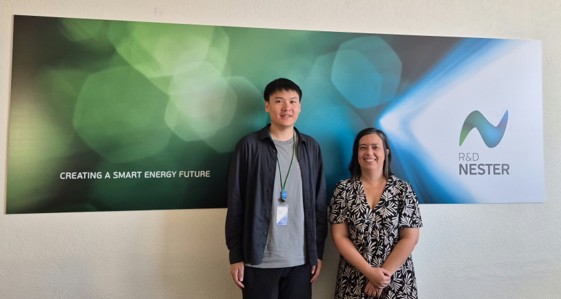
Between 18 September and 18 October 2026, Hou Kun, from the China Electric Power Research Institute (CEPRI), participated in a technical exchange with R&D Nester’s team within the scope of the GENESIS project – ”Joint Optimized Operation Technology of Electricity-Hydrogen-Ammonia Integrated System for New Energy Consumption”.
The work aimed to establish the technical and mathematical foundations for the future development of a dynamic Air Separation Unit (ASU) model for integration into a green ammonia production chain.
During the visit, three nitrogen production technologies were assessed:
• cryogenic air separation,
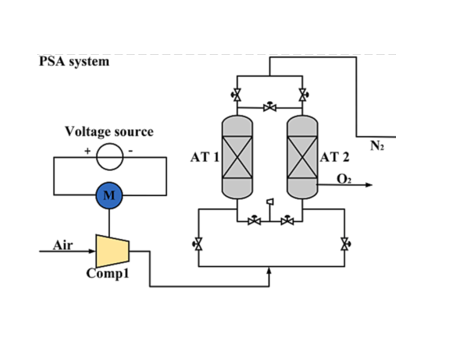
• Pressure Swing Adsorption (PSA),
• and membrane separation.
The comparison considered nitrogen purity and recovery, electricity consumption, operating pressure, plant scale, turndown capability, start-up and shutdown characteristics, and compatibility with variable renewable electricity.
Based on this assessment, PSA was identified as the most suitable technology for the GENESIS case study, particularly where operational flexibility and the ability to respond to variations in renewable electricity availability are important.
A reduced-order dynamic representation was proposed to model nitrogen production and purity, outlet pressure, and electricity consumption, while maintaining a suitable level of complexity for integrated electricity, hydrogen and ammonia system simulations.
The work resulted in a technology assessment report and a detailed theoretical specification for the dynamic ASU model.
The documentation defines the PSA model structure, the main mass-balance and energy-consumption equations, input and output variables, required technical parameters, modelling assumptions, and interfaces with the other components of the Power-to-Ammonia system.
This work provides R&D Nester with a consolidated technical basis for the future implementation and integration of the model into the GENESIS simulation environment.
The visit also strengthened knowledge of air separation technologies, dynamic PSA behaviour, flexible nitrogen production, and the integration of industrial processes with renewable energy sources.
A particularly relevant aspect of the work was the need to balance purity, efficiency and flexibility.
Although cryogenic separation is well suited to large-scale plants requiring very high nitrogen purity, PSA offers greater operational flexibility and shorter response times, which are important characteristics for ammonia production systems supplied by variable renewable electricity.
For more information: